



This is a guest post by Luca Foppoli .
He writes The Intentional Manager, a newsletter for the corporate professional who is tired of surface-level advice — each issue working to understand the why behind strategy, leadership and execution, from first principles.

“Great job with the presentation! Just change [X], [Y] and [Z] and it will be ready to go.”
You noticed what could be improved and you jumped in. You demand and expect excellence from your team and excellence was that extra tweak to the slides. You have been doing this for years and you were the only one who could catch this - and that’s why you intervened.
You did the right thing.
Did you?
What happens when you intervene
No, you didn’t.
Think of it this way: if you invite friends for dinner and they bring the ice cream, that’s fine. But if they bring the appetizer, the first and second course, the ice cream and the wine, it goes from being “your dinner” to “their dinner at your house”. Being educated, you will still go through the motions and smile, but your heart will no longer be in it.

And so he will thank you and implement the suggestion, but he will be disconnected and will withhold the discretionary effort necessary to go from average to great.
And so he will not exert any effort, because waiting for you is cheaper and safer. He will be an addict to your heroin. You will be exhausted for being everywhere and satisfied for still being the best at your craft. In reality, you are the bottleneck and the cap on what your team can achieve.
And so he will not level up, because learning happens in the last, uncomfortable, 10% and you are taking that away. He will sit comfortably, avoid stress and call it work-life balance. You will keep the team sheltered and safe, believing you are being a very good manager indeed. In reality, the team stalls and you are the culprit.
The team’s capabilities will drop and the multiplication of output you should be after as a manager will never happen.
The pushback
“I am their manager, of course I need to intervene! Otherwise, what do I do!? Should I just accept subpar output to preserve my team’s ego?”
You exist to multiply your team’s overall output, not to maximize the single unit of work.
To achieve it, the whole team needs to own whatever it is that they do, which will push them to level up; if you step in, you remove the very ownership needed to multiply.
That said, “not stepping in” differs from “abdicating any responsibility and standard” - in practice:
instead of giving them the answer, provide them the context and the mental models to reach an acceptable solution themselves;
instead of fixing the slides, explain why it’s important to make them a certain way and ask them to revise their work accordingly;
instead of telling them how you would present to the group, tell them what you expect the presentation to deliver, walk them through the few key concepts necessary to present well and let them build their own script and presentation style.
So when should you intervene?
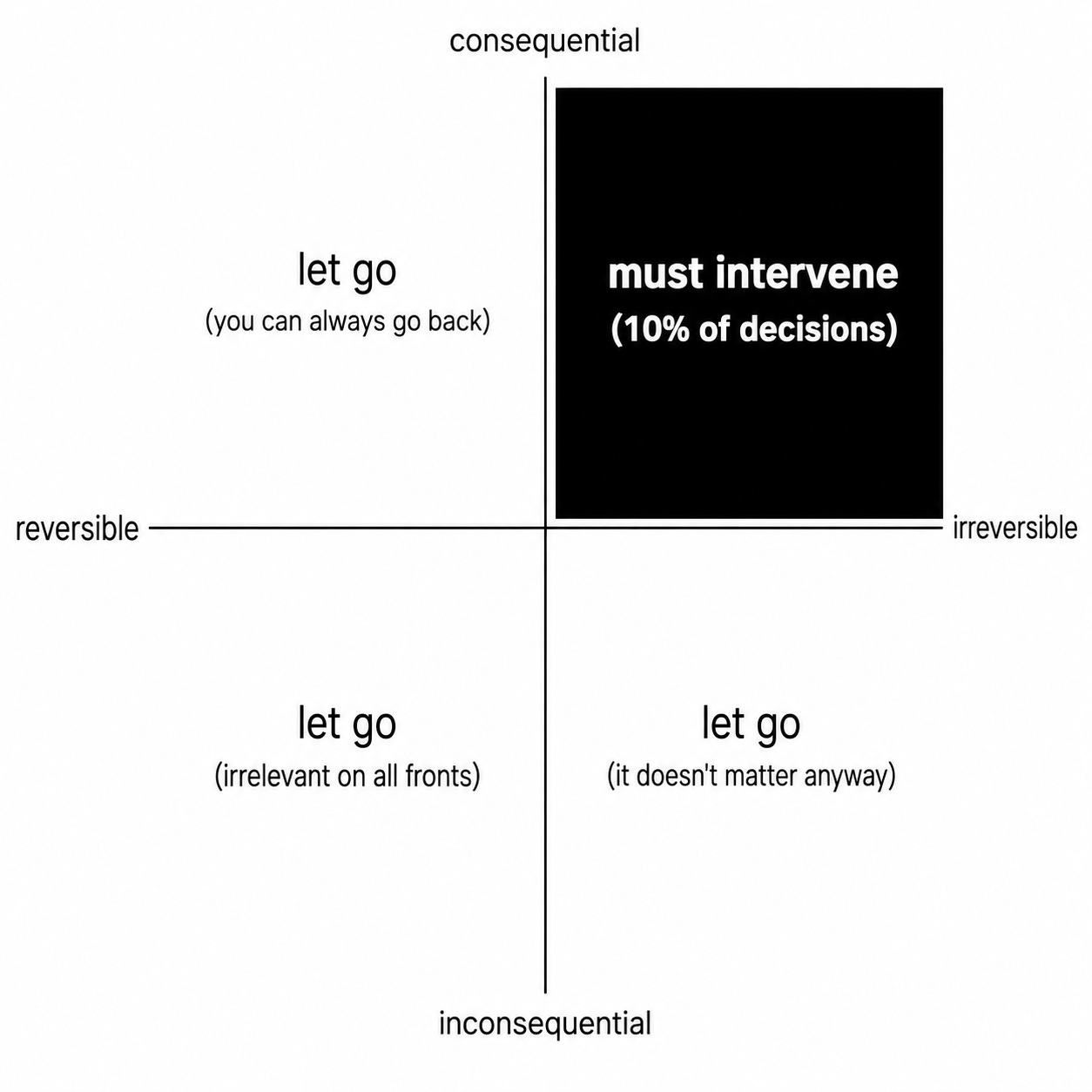
If a decision is consequential AND irreversible, then you MUST step in.
Consequential: the decision has actual impact.
Irreversible: the cost of reversing the decision is high.
Here you cannot afford to go wrong, because the damage is real and going back costly. In these cases, stepping in is required and to hell with the team’s sense of ownership; in any case, if you’ve let them decide on everything else, they will have enough in their ownership bank account to survive a withdrawal.
Every other decision, either inconsequential or reversible or both, should be left to the team.
If it’s consequential but reversible, it will have an impact, but it will be relatively easy to change. If it’s irreversible but inconsequential, you won’t be able to change it, but who cares anyway.
Spoiler: 90% of the decisions fall in this group.
Graphically:
The temptation to step in and improve things is always there.
And yet, every time you do it, you lower the team’s capability and ownership, creating long-term damage.
Tread carefully.
Thanks for reading,
Luca
And thank for writing for Leading in Product, Luca!
Benedikt
Of course you can do that! And you should.
But only when it truly matters, lest your people feel that *you* are the one making a decision and engagement and accountability drop.
I have no idea how the military works, but interesting to hear it is different though: how does it work there? When the manager steps in to correct irrelevant stuff, do people feel more disengaged because of it or more motivated by it?
Baloney. The view a manager or a leader has is broader and worthy of consideration, just as your subordinates views are worthy of consideration. You can step in at any of those quadrant by offering suggestions not pushing changes. You can discuss changes you believe are important and decide together if they are warranted. You can elicit from your subordinates the direct, secondary, and tertiary effects of decisions, too. This approach helps your subordinates develop their thinking to see a broader picture and consider what you need from them from that view too.
Talking about this like it is a dinner is a silly and limited analogy. I find nearly all analogies extremely limited because they are overly simple. And even if it is someone else's dinner in my house, I can still be a good host and focus on the mission of creating an atmosphere where people can share good food and celebrate coming together.
If you haven't built that kind of mission orientation into your people, you have failed as a leader and manager. From your POV, the military would never work. Funny that it does, and veterans are in such demand as employees.